
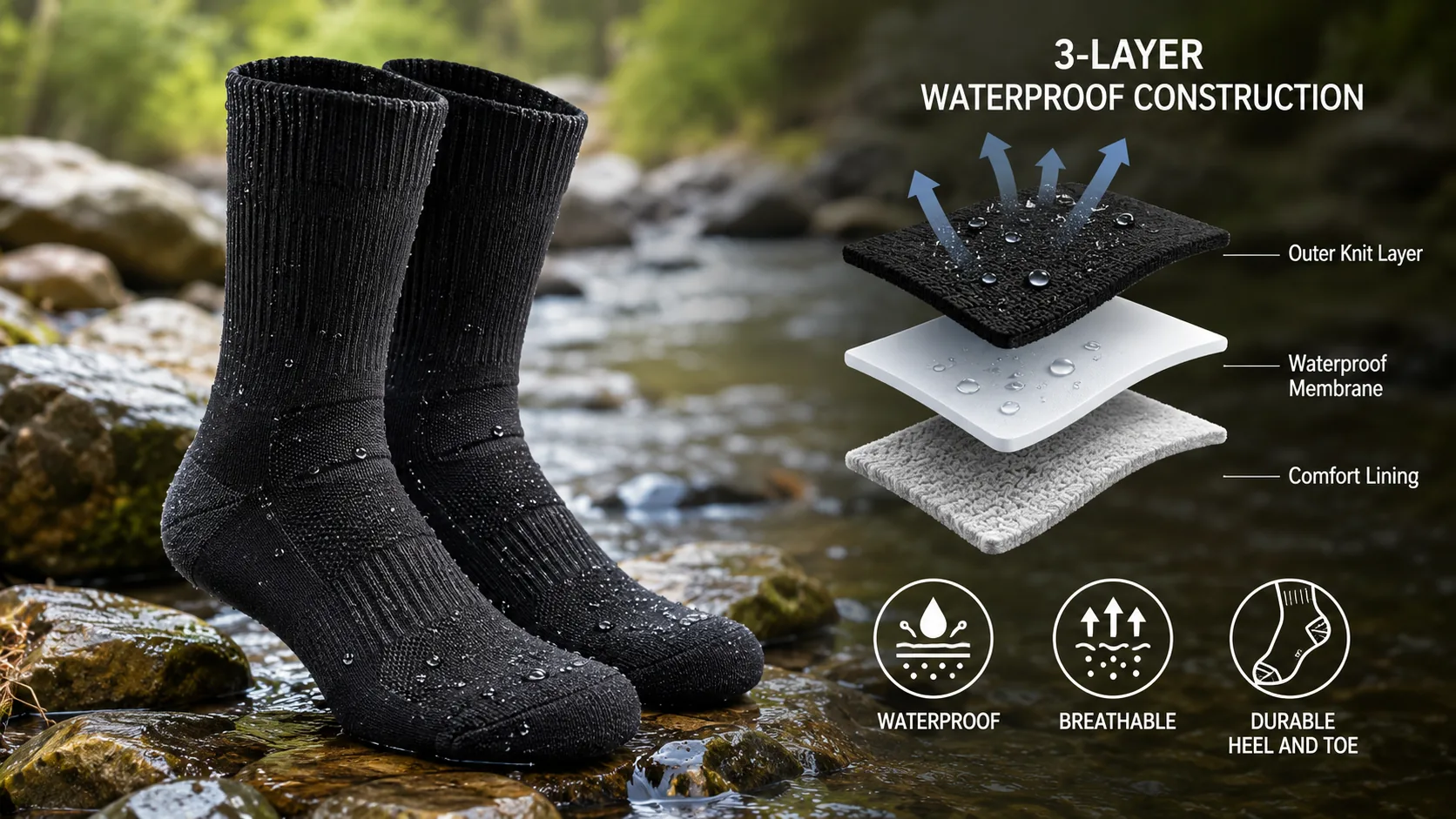
How the middle membrane controls waterproof sock performance
In a three-layer waterproof sock, the membrane is the functional barrier between the protective outer knit and the skin-facing lining. Buyers should evaluate it as part of a complete bonded construction because membrane data alone does not predict finished-sock fit, comfort or durability.
The membrane is the waterproof barrier
The outer knit of a waterproof sock may become visibly wet during use. That does not automatically mean the sock has failed. The middle waterproof breathable membrane is designed to resist liquid water moving through the sock body, while the inner lining provides comfort and manages moisture next to the foot.
This distinction matters for product pages and customer service. Describing the outer textile as a water-repellent coating can misrepresent a true three-layer product. A more accurate explanation is that the waterproof function comes from the internal membrane protected by knitted outer and inner layers.
Breathability is a system result
A breathable membrane can allow moisture vapor to move, but the wearer still produces heat and sweat. Outer yarn density, lining absorption, sock thickness, shoe ventilation, activity level and weather all influence how dry the foot feels. A membrane specification should therefore be considered alongside the complete sock and intended footwear.
Buyers planning cycling or warm-weather products may favor a thinner outer and moisture-managing lining. Cold-weather products may use merino wool or warm terry and accept a warmer feel. The correct choice is not the membrane with the largest marketing number; it is the construction that performs consistently in the intended use.
Ask for the test method, not only a headline number
Waterproof and moisture-vapor results can vary with the test method, specimen preparation and units used. A buyer should ask which laboratory method was used, whether the report covers the membrane material or the finished sock, when the test was completed and whether the tested construction matches the proposed order.
Do not compare two numbers from different methods as if they were identical. If a brand wants to print a performance figure on packaging, the wording, units and tested item should match the supporting evidence. Destination-market rules and retailer claim policies should also be checked before final artwork is released.
Lamination protects the membrane but adds complexity
The membrane cannot work well if it shifts, wrinkles, tears or separates from the textile layers. Bonding must keep the three layers stable while preserving enough stretch for the foot and ankle. Excess adhesive, uneven pressure or incorrect heat conditions can change hand feel, elasticity and vapor movement.
Sampling should include repeated flexing, inside-out inspection where appropriate, dimensional checks and wear in actual shoes. Buyers should also observe the sock after washing and drying according to the proposed care instructions. A membrane material can pass a flat test while a poorly constructed finished sock still creates complaints.
The cuff remains an opening
The membrane protects the sock body, but a standard cuff is not a sealed closure. Water can enter from the top when the wearer steps into water deeper than the sock height or when rain runs down the leg. Knee-high products increase coverage but do not turn the opening into a watertight seal.
Packaging and listings should explain this boundary. Avoid presenting standard waterproof socks as swimming equipment or as suitable for unrestricted submersion. For creek crossings or heavy runoff, cuff management, trousers, gaiters or a purpose-designed strap system may reduce entry, but samples still need scenario-specific testing.
Match membrane construction with target footwear
A waterproof sock must stretch over the foot and still fit inside footwear. A thick membrane package may feel protective but can make cycling shoes or fitted casual shoes too tight. A thinner package may improve mobility but needs adequate protection from abrasion and repeated flexing.
Ask wear testers to use the exact shoe categories planned for the product: hiking boots, work boots, cycling shoes, running shoes or commuter footwear. Record pressure at the toes, heel movement, arch feel and cuff comfort. Fit observations often reveal more useful information than a material data sheet alone.
Control membrane claims in OEM production
The approved sample should identify the membrane and the complete layer combination. Bulk inspection can then compare thickness, dimensions, stretch, appearance, water performance and care response with the approval standard. Any material substitution should be confirmed before production rather than discovered during final inspection.
For private label projects, keep the test report, specification, packaging claim and website wording aligned. If evidence supports only the material, do not automatically claim that every finished size has an identical result. Confirm the claim scope with the waterproof socks factory and use accurate language that can be explained to customers.
Questions to send the factory
Ask what membrane is used, how it is bonded, which outer and lining materials protect it, what finished-product tests are available and which care method is recommended. Also ask whether the proposed construction has been sampled in the height and size range you plan to order.
A useful membrane discussion includes the target activity, climate, shoe type, sock height, warmth level and retail claim. Zhuji Routing Knitting Co., Ltd. can then develop a three-layer sample and explain which parts of the specification are confirmed by material documents and which require finished-sock testing.
Waterproof Sock Membrane Guide for OEM Buyers FAQ
Which layer makes waterproof socks waterproof?
The middle waterproof breathable membrane is the main barrier against liquid water passing through the sock body.
Does a breathable membrane keep feet completely sweat-free?
No. Comfort also depends on the lining, outer knit, thickness, footwear, activity and weather.
Can membrane test numbers from different methods be compared directly?
Not always. Buyers should confirm the test method, units, specimen and whether the result applies to the material or finished sock.
Can water enter over the cuff?
Yes. A standard cuff is an opening, so water can enter when the water level or runoff rises above it.
Should private label packaging print membrane performance figures?
Only when the wording and units are supported by relevant evidence and suitable for the destination market and retailer requirements.