
What do waterproof sock ratings really mean?
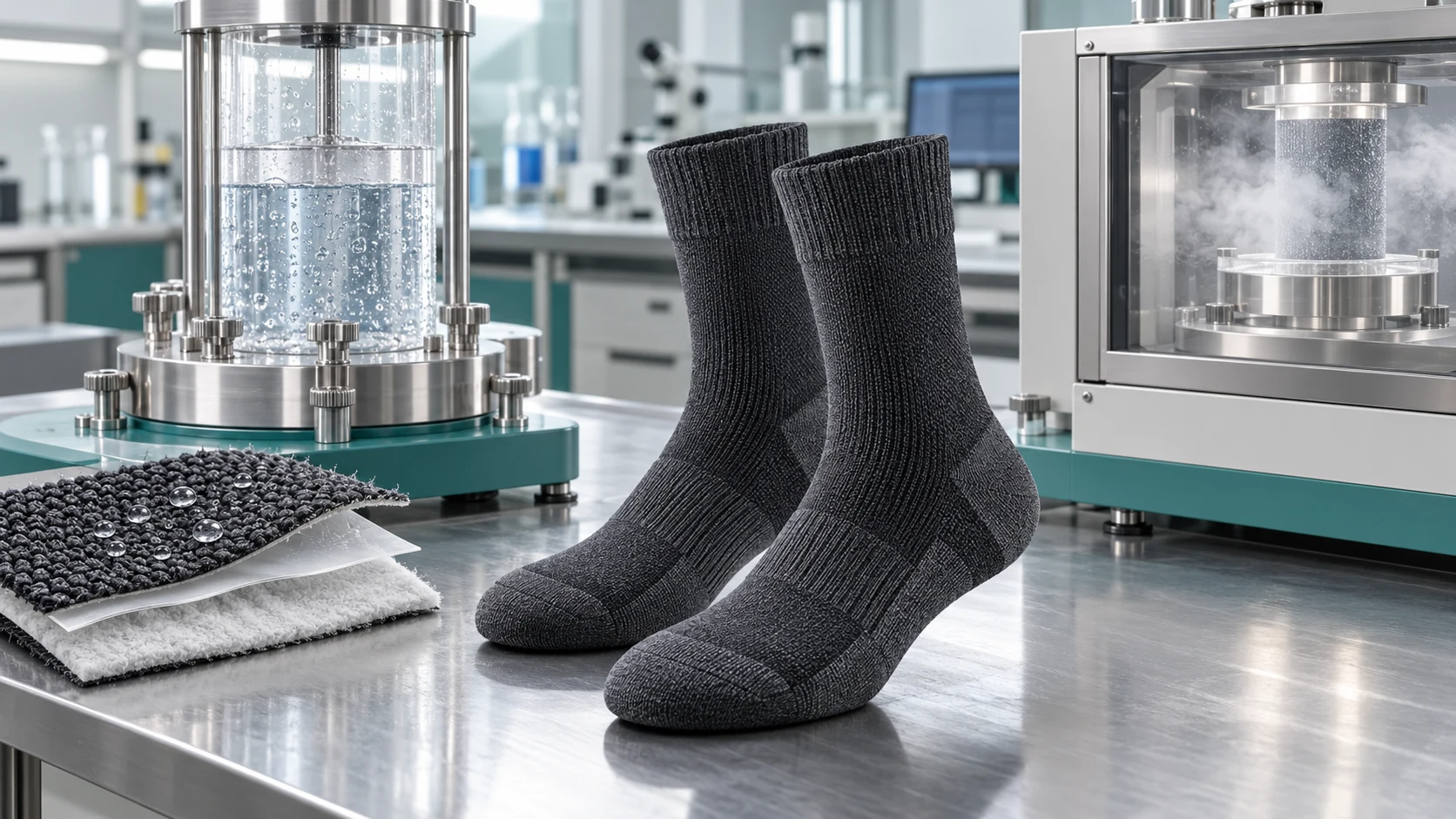
Hydrostatic head describes resistance to water penetration under a defined pressure test. MVTR describes water-vapor transmission under a named method and set of conditions. Ret describes water-vapor resistance, so a lower Ret result means less resistance in that method. None of these numbers, by itself, proves that a finished sock will never leak or that every wearer will feel equally dry. An OEM buyer should identify the exact specimen and method, compare only like-for-like results, and add finished-sock checks before and after laundering, stretching and flexing.
- Hydrostatic head
- Measures resistance to water penetration under increasing pressure on a textile specimen.
- MVTR
- Reports water vapor passing through a specimen under one defined method and environment.
- Ret
- Reports evaporative resistance; within the same method, a lower value means less resistance.
- Method matters
- Numbers from different test methods or conditions are not automatically equivalent.
- Specimen matters
- A membrane, laminate and complete sock answer different performance questions.
- Age the product
- Repeat critical checks after agreed washing, stretch and flex exposures.
1. Start with the question, not the marketing number
Buyers often receive a membrane data sheet with a waterproof figure, a breathable figure and little context. Before comparing suppliers, decide what the data needs to support. Are you screening membrane options, approving a laminated three-layer assembly, checking production consistency or validating the complete sock after use-related aging? Each question may require a different specimen and procedure.
Request the standard and edition, laboratory, specimen description, conditioning, test direction, units and individual results. A report for a free membrane film cannot be silently transferred to a knitted and laminated sock. Adhesive coverage, outer and inner yarns, stretch, thickness and the manufacturing process change the assembly. Treat the headline number as one line of evidence, not the product claim.
2. Hydrostatic head is a controlled material test
ISO 811:2018 describes a hydrostatic-pressure method for determining the resistance of textile fabrics to water penetration. In principle, one face of a conditioned specimen is exposed to steadily increasing water pressure until penetration is observed. The result is tied to the selected procedure, specimen orientation and endpoint.
This method is useful for comparing a membrane or laminate under controlled conditions. It does not include the open cuff, three-dimensional shaping, every local bond condition or the stresses introduced when a sock is pulled over a foot and flexed inside footwear. For sourcing, record whether the specimen was membrane film, finished laminate or another defined material, and do not label the result as a guaranteed pressure rating for every finished sock.
3. Why a high hydrostatic result does not mean “never leaks”
A waterproof sock has an intentionally open top. Water can enter over the cuff, and moisture can also arrive from perspiration or from exterior water transferred inside during handling. A very high material result does not diagnose these routes. Nor does it show how a laminate will behave after repeated donning, ankle flex, heel abrasion, washing or drying.
Add a repeatable finished-sock check with the water level safely below the cuff. Define water depth, time, movement, temperature, internal indicator and handling. Test an approved sample before aging and repeat the same setup after agreed wash, stretch and footwear-flex checkpoints. The related pre-bulk waterproof testing guide explains why below-cuff control is essential.
4. MVTR is a method-dependent water-vapor result
Moisture vapor transmission rate, commonly written as MVTR or WVTR, expresses how much water vapor passes through a specimen under specified test conditions. Results are often reported in grams per square meter over 24 hours. A higher value can mean greater vapor transfer only when the specimens were tested using the same method, setup, environment and reporting basis.
Temperature, humidity gradient, air movement, cup orientation, liquid or desiccant configuration, specimen sealing and exposed area can all affect the result. It is therefore unsafe to rank one “10K” or “20K” data sheet against another unless the underlying method and conditions match. Request the complete test report and compare like with like rather than treating every MVTR number as one universal scale.
5. ISO 15496 is a quality-control method, not a comfort class
ISO 15496:2018 specifies a simplified method for measuring water-vapor permeability of textiles for quality-control purposes. The standard’s scope cautions that the result cannot be used to classify clothing according to physiological comfort and does not correlate with dry-desiccant methods because the procedures are different.
That limitation is valuable for buyers. ISO 15496 can support controlled comparison or production monitoring when all parties use the same setup, but it should not be converted into an absolute promise that a wearer will not sweat. Sock comfort also depends on inner-yarn moisture management, thickness, size, activity, footwear ventilation, temperature and the user’s sweat rate.
6. ISO 11092 reports water-vapor resistance as Ret
ISO 11092:2026 covers measurement of thermal resistance and water-vapor resistance under steady conditions using the sweating guarded-hotplate method. It can be applied to fabrics, films, coatings, foams and multilayer assemblies. For water-vapor resistance, the commonly used result is Ret.
Ret works in the opposite direction from a “higher is more breathable” MVTR reading: within this method, a lower Ret means the specimen offers less resistance to evaporative heat transfer. The standard also notes that its conditions do not model one specific comfort situation. Report the full assembly, orientation and method; do not convert Ret into an unsupported MVTR value or a universal wearer-comfort claim.
7. AATCC TM204 provides another defined vapor-transmission route
AATCC TM204-2025 is a water-vapor transmission test method for textiles. Depending on the reporting option, results may be expressed as relative water-vapor transmission or as mass per area over time. It gives buyers another structured way to compare materials when specimens are prepared and tested consistently.
The method name and edition belong beside every result. “MVTR tested” is incomplete without the procedure, specimen and conditions. If Supplier A reports TM204 and Supplier B reports another cup method, the larger number is not automatically the better material. Ask one laboratory to test all shortlisted constructions under one agreed method when a direct sourcing comparison is important.
8. Test the membrane, laminate and sock for different reasons
A free membrane film isolates the barrier technology. A laminate includes the outer knit, adhesive distribution, membrane and inner lining, so it is closer to the real construction. A finished sock adds shaping, reinforcement, local strain, decoration, cuff design and manufacturing variation. No single specimen replaces the others.
- Membrane filmUse for basic barrier screening and supplier material control.
- Three-layer laminateUse to assess how face fabric, lining and bonding affect water and vapor performance.
- Finished sockUse for below-cuff leakage, fit, construction consistency and real-shape stress.
- Aged laminateUse to identify changes after agreed washing, heat, flex or stretch exposure.
- Aged finished sockUse to confirm that the approved product remains functional at planned checkpoints.
- Production sampleUse defined lot sampling to connect bulk manufacture with the approved reference.
9. Build a comparison table that prevents false equivalence
Put each result in a structured matrix instead of copying isolated values into a quotation. Required fields should include supplier, material code, lot, construction, method and edition, test house, conditioning, specimen face and orientation, units, individual values, average, deviations and whether the sample was new or aged.
Group results only when methods and conditions match. Keep hydrostatic pressure, MVTR and Ret in separate columns because they answer different questions. If the laboratory changes a condition or specimen sealing route, record it rather than merging the data with the original series. This discipline turns technical data into a repeatable sourcing decision and prevents an attractive headline from overriding a weaker construction.
10. Include aging and complete-product acceptance
Performance should be checked at the stage where the brand plans to make its claim. If the product is promoted for repeated use, agree how many wash, dry, stretch and flex cycles will be applied before retesting. Use the same care route intended for the consumer label and retain an untreated or unaged control from the same sample set.
Evaluate layer adhesion, wrinkles, bubbles, dimensions, elasticity, appearance and footwear fit alongside the functional results. A construction may retain a strong material pressure result yet become uncomfortable, distorted or locally separated. The durability testing guide provides a checkpoint framework for washing, stretching and delamination review.
11. Put method and scope beside every product claim
Buyers should avoid claims such as “completely breathable,” “never leaks” or “guaranteed 20K waterproof” unless the wording accurately reflects validated product evidence and applicable market rules. A more defensible technical specification identifies the material or assembly, test method, target and quality-control stage.
Sales pages can explain that the product uses a waterproof breathable membrane and has been evaluated under named procedures, while care instructions explain the open cuff and correct use. Keep supplier material declarations, laboratory reports, approved samples and bulk QC records together. This gives distributors and retail teams a traceable foundation for their own market-specific claim review.
12. Send a complete performance brief with the RFQ
A useful RFQ states the use case, climate, footwear, sock height, thickness, yarns, lining, size range and intended care route. Add the exact performance question: membrane screening, laminate qualification, finished-sock leakage, aged performance or production consistency. Name required methods when the brand already has a standard.
Ask the supplier to identify what is tested in-house, what requires a third-party laboratory and which costs or lead times apply. Approve the test plan before samples are made, then link the passed construction and component codes to the tech pack. The waterproof sock tech pack guide shows how to record these decisions for sampling and bulk production.
Waterproof Sock Ratings FAQ
What is hydrostatic head for waterproof socks?
It is a material-level measure of resistance to water penetration under increasing
hydrostatic pressure. The report should name the method, specimen, orientation,
conditions and endpoint. It does not by itself guarantee that a complete sock will
never leak.
Does a higher hydrostatic-head number always mean a better sock?
No. It may indicate stronger pressure resistance for comparable specimens tested by
the same method, but fit, vapor transfer, flex durability, adhesion, lining, weight
and finished-product consistency also matter.
Can MVTR numbers from different methods be compared directly?
Not reliably. Test configuration, temperature, humidity, air movement, specimen
sealing and reporting basis can produce different values. Compare results only when
the method and relevant conditions match.
Is a higher MVTR always more breathable?
Within the same test method and conditions, a higher transmission result can indicate
greater vapor transfer. Across different methods, a larger number is not necessarily
better and should not be treated as a universal comfort score.
What does a lower Ret value mean?
Under ISO 11092, a lower Ret means the specimen provides less resistance to water-vapor
transfer in that test. Ret should not be converted directly into an unrelated MVTR
figure or a guarantee of wearer comfort.
Should the membrane or complete waterproof sock be tested?
Both can be useful for different reasons. Membrane and laminate tests help control
materials; a finished-sock test evaluates the constructed product. Buyers should
keep the results separate and define which specimen supports each claim.
Why repeat performance checks after washing and stretching?
Laundering, drying, donning and movement can affect adhesion, elasticity and local
barrier performance. Retesting at agreed checkpoints shows whether the approved
construction remains suitable after realistic aging exposures.
What information should appear on a waterproof test report?
Include product and lot identity, specimen type, method and edition, conditioning,
orientation, units, individual results, average, deviations, laboratory, date and
whether the sample was new or aged.