
How should OEM buyers test waterproof sock durability?
Start with an approved, conditioned sample and record its finished-sock waterproof result, dimensions, mass, stretch recovery, appearance and layer condition. Apply the agreed laundering, drying, repeated-stretch and footwear-wear exposures, then repeat the same measurements. A useful durability conclusion comes from the change between controlled checkpoints—not from a single new-sock test or an unsupported promise that every waterproof sock will survive the same number of washes.
- No universal cycle life
- Construction, care conditions, footwear, fit and acceptance limits determine the relevant durability target.
- Baseline first
- Measure waterproof performance, dimensions, elasticity, appearance and adhesion before aging.
- Control the care route
- Record machine type, temperature, detergent, load, drying method and number of cycles.
- Test the finished sock
- Material-level hydrostatic data cannot prove that every finished product is leak-free.
- Inspect layer movement
- Wrinkles, bubbles, stiffness and local separation can reveal lamination stress.
- Approve by checkpoint
- Define pass limits and actions for the new sample and each agreed durability stage.
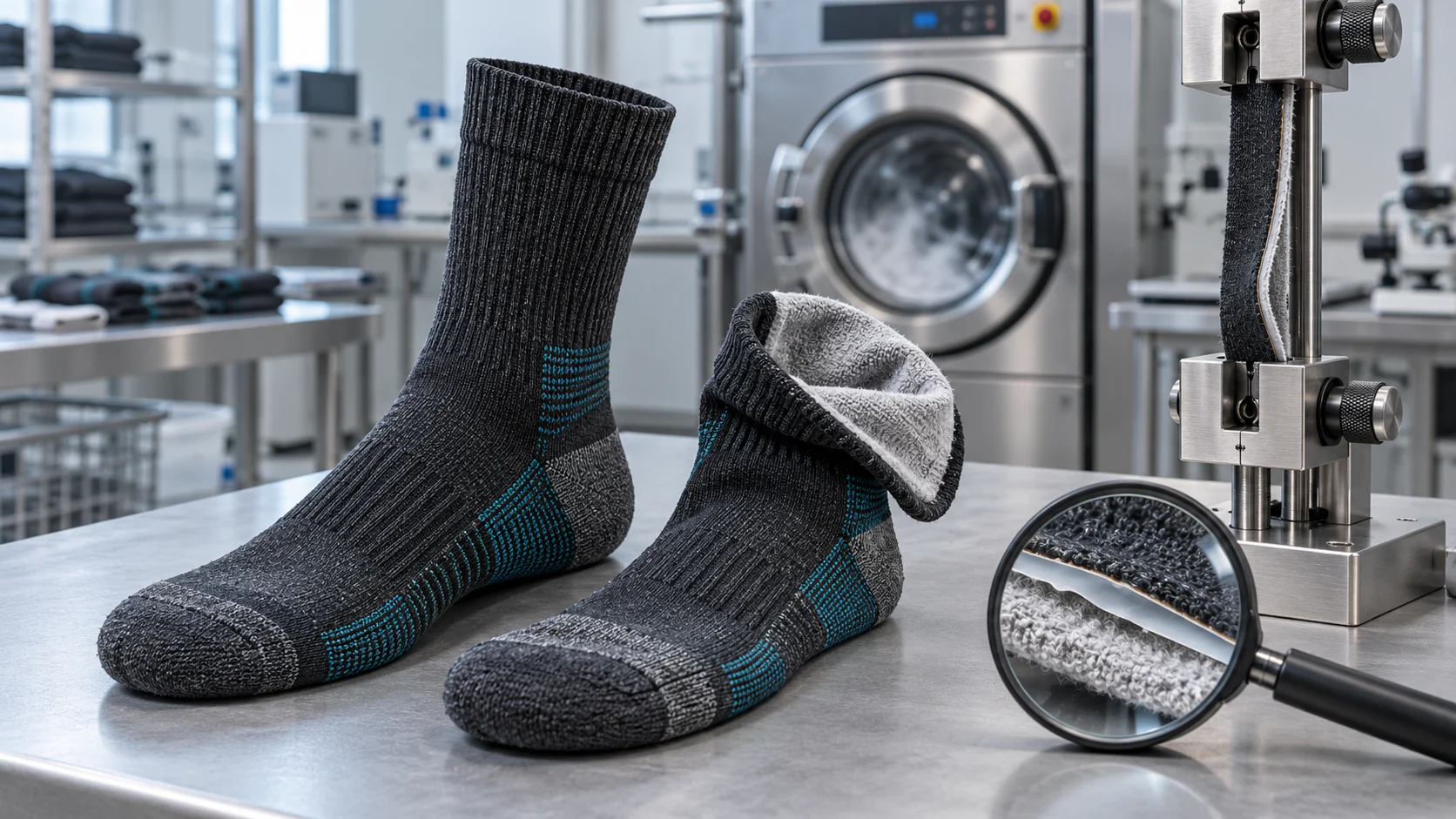
1. Do not promise a universal number of washes
“How many washes do waterproof socks last?” sounds simple, but there is no honest universal answer. A three-layer sock combines knitted outer and inner structures, elastic yarns, a functional membrane, adhesive distribution, reinforcement and decoration. Different wash temperatures, detergents, drying heat, footwear pressure, fit and user movement place different loads on those components.
A buyer should define a durability target for one product specification and one care route. For example, a lightweight cycling sock and a thicker winter terry sock may need different checkpoints even when both use a waterproof breathable membrane. Treat cycle counts as validation conditions, not a transferable lifetime guarantee. If a quotation includes a wash claim, request the exact sample, method, conditions, result and acceptance criteria behind it.
2. Create a complete baseline before any aging exposure
Condition the approved sample according to the agreed laboratory or internal procedure, then assign a traceable identification. Photograph both socks and record size, color, yarn and membrane lots, construction version, decoration method and production date. Measure the foot length, leg length, cuff width and other critical dimensions at defined points without changing the tension from one checkpoint to the next.
The baseline should also include the finished-product leak test, specified material data, mass, stretch and recovery, visual layer condition, hand feel and fit in the target footwear. Without this starting record, a post-wash wrinkle, size change or stiff area cannot be attributed confidently to aging. Keep an untouched control pair from the same approved sample set for side-by-side review.
3. Define washing and drying conditions in writing
ISO 6330 provides standardized domestic washing and drying procedures for textile testing, including defined washer types, reference detergents and multiple drying routes. It does not tell every brand which condition to choose. The buyer, factory and test lab must select a procedure that matches the intended care label and target market.
Record machine type, water temperature, program, detergent, ballast or load, spin, drying method and rest time between cycles. One “wash” performed in warm water and air dried is not comparable with a hotter cycle followed by tumble drying. Do not introduce bleach, softener or a high-temperature route unless it is part of the product’s approved care plan. Test instructions and consumer care labeling should describe the same practical limits.
4. Separate material water-pressure data from finished-sock performance
Hydrostatic-pressure methods are useful for comparing barrier materials. The AATCC standards directory lists TM127 for water resistance by hydrostatic pressure, while ISO 811 addresses resistance of textile fabrics to water penetration under hydrostatic pressure. A lab should select the applicable method, current edition, specimen preparation and reporting basis.
These fabric or laminate results answer a material question; they do not include every stress introduced by knitting, lamination, shaping, decoration and finished use. A finished waterproof sock therefore needs its own controlled water test before aging and at the agreed checkpoints. Report material and product results separately instead of combining them into one unsupported “waterproof rating.”
5. Repeat the finished-sock test below the open cuff
A normal waterproof sock has an open top. Use a dry, conditioned sock, keep the water level safely below the cuff and prevent splash or wicking over the opening. Control depth, duration, movement, temperature and the internal indicator or test form. Remove exterior water before handling the cuff so droplets are not transferred inside during removal.
Use the same setup at baseline and after every durability stage. Record whether the result is dry, generally damp or localized at a repeatable point. A localized change can be mapped to a heel, toe, ankle flex zone or footwear contact area for further investigation. Immersing the open cuff does not isolate membrane performance and should not be reported as a finished-sock leakage result.
6. Repeated stretch can reveal bond and construction weaknesses
Socks expand every time they are pulled on and continue to flex during walking, cycling and other movement. A durability program should therefore include a defined stretch direction, extension, cycle count, speed and rest period. Test the complete size range or at least the highest-risk sizes, because a shared construction may be strained differently at the limits of a size band.
A 2026 peer-reviewed study of one prototype waterproof breathable sock construction reported water resistance above 1300 mmH₂O after 100 cycles of 50% course-direction extension, while its observations also connected inner-layer delamination behavior with knit structure. This is useful evidence that stretch, adhesive design and knit structure should be evaluated together. It is not proof that every commercial sock, membrane or adhesive will produce the same result.
7. Inspect for delamination before it becomes a visible leak
Delamination is partial or complete separation between layers. Early signs may include a bubble, loose-feeling zone, persistent wrinkle, internal ridge, local stiffness, unusual noise or an area where the lining moves independently. Check the toe, heel, ankle flex, cuff transition and any position repeatedly compressed by footwear.
Conduct a non-destructive visual and hand inspection before cutting any sample. If a cross-section or peel investigation is required, keep an untouched control and map the exact location. Separate cosmetic layer movement from a functional failure using the agreed acceptance matrix and finished-sock retest. The root cause may involve adhesive coverage, curing, knit geometry, contamination, heat, stretch or a combination of factors.
8. Measure dimensions, elasticity and fit after aging
A waterproof sock can remain leak-free but still become unsuitable if it shrinks, grows, twists, loses cuff recovery or no longer fits the intended footwear. Measure the same marked points after the specified conditioning period. Record both the absolute dimensions and percentage change, then compare the result with the approved size chart and tolerance.
Repeat donning, stretch recovery and footwear-fit checks at each planned stage. Pay attention to pressure at the toe and instep, folds under the sole, heel alignment and cuff stay-up. Laminated constructions can feel less forgiving than ordinary socks, so size grading and thickness must be approved with the complete product—not inferred from an unlaminated knit shell.
9. Include abrasion and real footwear contact zones
Washing and stretching do not reproduce every use condition. Rough boot seams, debris, tight heel counters and repeated toe flex can abrade the outer knit and concentrate stress on the laminate beneath it. Add controlled abrasion or wear trials appropriate to the buyer’s market, and use the actual footwear categories expected for hiking, cycling, fishing, workwear or winter use.
Document the footwear model, sock size, trial duration, surface condition and wear location. Inspect pilling, thinning, broken yarn, reinforcement movement and local loss of shape before repeating the waterproof test. An abrasion method for one flat textile does not automatically predict a three-dimensional sock inside a shoe, so combine standardized material data with finished-product wear evidence.
10. Use planned checkpoints instead of testing only at the end
Checkpoints make it possible to see when performance begins to change. The exact sequence depends on the program, but buyers may approve a new sample, then compare it after selected wash cycles, stretch cycles and wear exposure. Testing only the final stage can hide whether a problem appeared early and remained stable or developed suddenly near the end.
- BaselineRecord dimensions, appearance, elasticity, fit, layer condition and finished-sock waterproof result.
- Care routeLock the washer, detergent, temperature, load, spin, drying method and conditioning time.
- Intermediate reviewRepeat critical measurements at agreed stages instead of waiting for the final cycle.
- Stretch exposureDefine direction, extension, speed, repetitions and sample size before testing.
- Wear exposureUse target footwear and inspect the heel, toe, ankle flex and instep contact zones.
- Waterproof retestUse the same below-cuff depth, time, movement, indicator and handling at every checkpoint.
- Failure mappingPhotograph and mark every change before destructive analysis or sample cutting.
- DecisionPass, investigate, rework or reject against written limits rather than visual preference alone.
11. Translate sample approval into bulk-order controls
Retain a signed reference pair and the test record that supports approval. The order file should identify critical yarns, membrane, adhesive or lamination route, reinforcement, size tolerances, care label, decoration and packaging. If a critical component or process changes, decide whether the durability program must be repeated before bulk release.
Bulk inspection can check appearance, measurements, pairing, labels, packing and a defined finished-sock water test on sampled units. It cannot recreate a long aging program on the shipment day. Use incoming material controls, in-process records and retained production samples to connect the approved design with the bulk lot. The bulk-order inspection guide and pre-bulk testing guide provide related planning steps.
12. Build an acceptance matrix that states what happens next
For each checkpoint, list the sample quantity, test condition, measured property, target, tolerance and evidence required. State whether one failed unit triggers a confirmation test, engineering review, lot hold or rejection. Keep functional and cosmetic criteria separate so a minor color change is not confused with a waterproof failure, and a serious leak is not hidden inside an average appearance score.
The matrix should also define who approves deviations and whether retesting uses the original sample, a replacement or a new production lot. Clear decision rules protect both buyer and factory from changing expectations after testing. They also create a useful record for future reorders, complaint diagnosis and construction improvement.
Waterproof Socks Durability Testing FAQ
How many washes should waterproof socks last?
There is no universal wash-life number for every waterproof sock. Buyers should set
a target for the specific construction, care route, use case and acceptance limits,
then validate that target with documented pre- and post-aging tests.
Why is a baseline test necessary before laundering?
A baseline records the new sample’s waterproof result, dimensions, elasticity,
appearance, fit and layer condition. Without it, a later change cannot be measured
consistently or linked confidently to the aging exposure.
Can ISO 6330 be used to test waterproof socks?
ISO 6330 provides standardized domestic washing and drying procedures for textile
testing. The buyer, factory and lab still need to select the procedure that matches
the intended care label and document all chosen conditions.
Does a membrane hydrostatic-pressure result prove the finished sock is waterproof?
No. Hydrostatic-pressure data helps compare barrier materials, but it does not cover
every stress from knitting, lamination, shaping, decoration and finished use. Test
the completed sock separately with the water level below its open cuff.
What are common signs of waterproof sock delamination?
Bubbles, loose-feeling areas, persistent wrinkles, internal ridges, local stiffness
or independent movement between layers can indicate separation. Confirm the effect
with controlled inspection and functional retesting before assigning the cause.
Why should repeated stretch be included in durability testing?
Socks stretch during donning and flex during movement. Repeated extension can reveal
changes in layer adhesion, elastic recovery, fit and waterproof performance that a
static new-sock test may not show.
Should every size be included in durability approval?
Test coverage should reflect risk. At minimum, review the limits of each size band
and any size that places unusually high strain on the construction, because one
shared material package can behave differently across the graded range.
What should a waterproof sock durability report include?
Include sample identity, construction version, conditioning, wash and dry settings,
stretch and wear exposures, checkpoint results, photographs, failure locations,
acceptance limits, deviations and the final approval decision.