
How should buyers specify odor control in three-layer waterproof socks?
Start with the consumer problem, not an ingredient name. Decide whether the product needs faster moisture transport, reduction of selected odor chemicals, control of bacteria on the textile, or a combination supported by separate evidence. Then identify which sock layer receives the technology and how performance will be verified before and after the agreed care cycles.
- Define the function
- Separate wicking, drying, deodorization and antibacterial textile activity.
- Select the layer
- Outer knit, inner lining and finished assembly have different contact and wash risks.
- Name the test
- Record the method, organism or odor chemical, specimen and calculation used.
- Verify wash life
- Retest after a defined number of standardized wash and drying cycles.
- Control the claim
- Textile-protection data does not automatically support a wearer-health claim.
- Lock bulk inputs
- Approved chemistry, yarn, dose, supplier, construction and care route need change control.
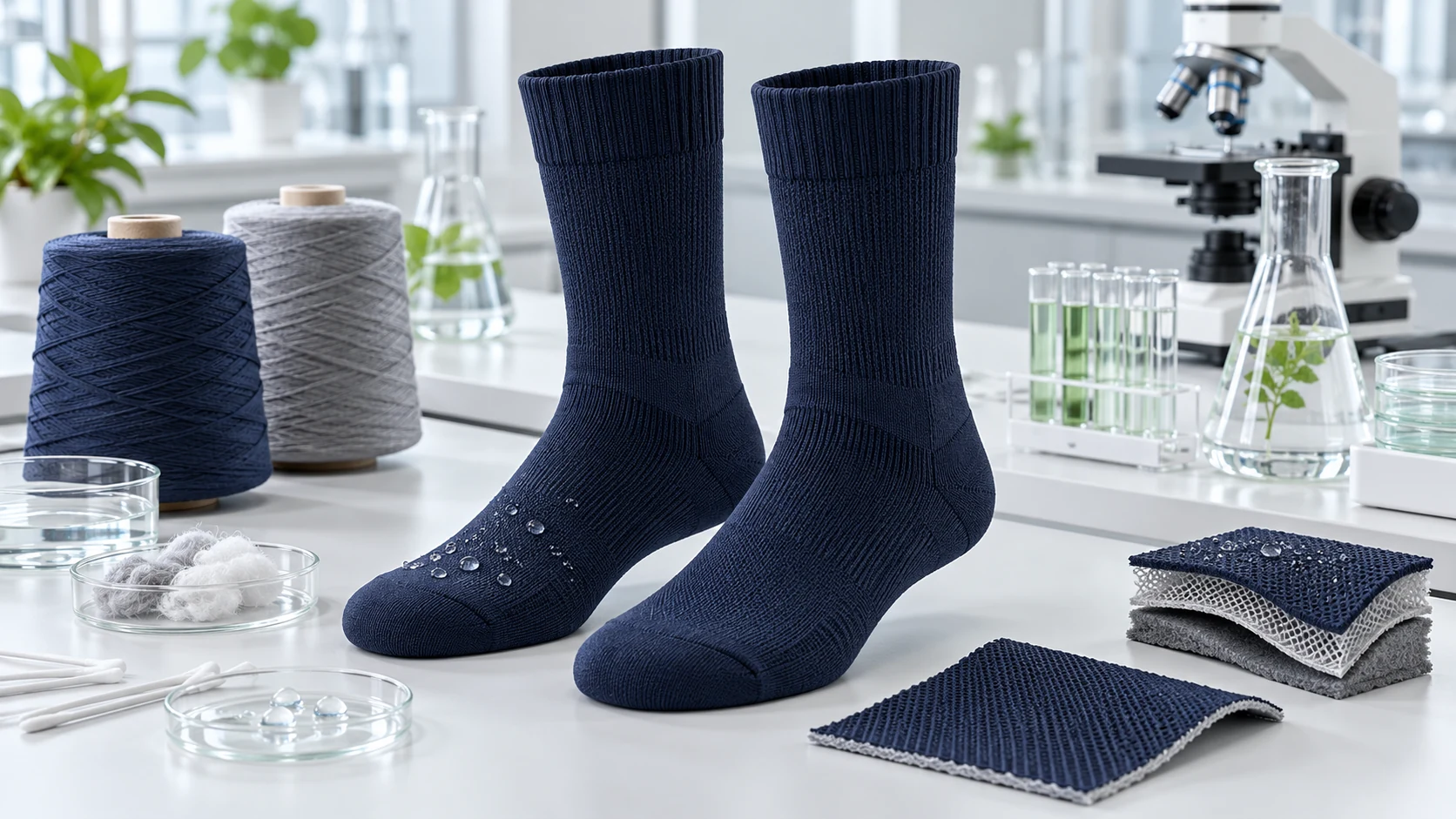
Four different functions are often hidden inside one request
Moisture wicking moves liquid perspiration across or away from a surface. Drying performance describes how quickly retained moisture leaves under defined conditions. Deodorization addresses selected odor chemicals. Antibacterial textile activity evaluates bacterial behavior on a treated textile under a named method. Improvement in one property does not prove the others.
This distinction matters in waterproof socks because the membrane blocks outside liquid water while the inner environment can still become warm and humid. A buyer may need a moisture-managing lining and an odor-control technology, but those are two specification lines with different evidence. Avoid compressing them into an unclear request such as “make it breathable and antibacterial.”
The three-layer construction changes the treatment plan
A typical product combines a protective outer knit, a thin waterproof breathable membrane and a next-to-skin lining. The inner lining receives the most direct contact with perspiration. The outer knit faces abrasion, rain, dirt and repeated rubbing inside footwear. The membrane provides the liquid-water barrier and should not be casually exposed to a new finish that could affect lamination or water-vapor transfer.
Buyers should review the treatment together with the complete three-layer material system. A successful swatch result does not release a finished sock unless the treatment is compatible with the yarn, dye, adhesive, membrane, stretch and labeled care route.
Choose the treated layer according to exposure and claim
Treating the lining can put the technology close to the source of perspiration and odor, but it also creates direct skin-contact and wash-durability questions. Treating an outer yarn can protect that textile surface yet may have limited relevance to odor generated inside the sock. Applying a finish to a complete assembly can simplify processing, but penetration, add-on uniformity and membrane compatibility need review.
The tech pack should name the treated component rather than saying only “antimicrobial sock.” Record whether the active route is built into a fiber or yarn, applied as a textile finish, or supplied through another documented material technology. The buyer should obtain supplier identification, recommended dose, restricted-substance data and a change-notification commitment without turning the ingredient into an unsupported consumer claim.
ISO 20743 evaluates antibacterial activity on textile products
ISO 20743:2021 specifies quantitative methods for determining antibacterial activity of antibacterial- treated textile products. Its scope can support evaluation of fibers, yarns, fabrics, clothing and other textile products regardless of the antibacterial agent or application route. The report still needs to identify the selected procedure, test organism, controls, specimen and result.
A numerical result under this method describes the tested textile under controlled conditions. It should not be rewritten as proof that the sock protects the wearer from infection or prevents a medical condition. The development team should also decide whether the tested specimen is the treated lining, a cut piece of laminated assembly or a representative finished-product zone.
AATCC TM100 is another quantitative textile route
AATCC TM100 assesses antibacterial finishes on textile materials using a quantitative procedure. If a buyer selects this route, the purchase file should state the method edition, organisms, contact time, control material and required result. A report titled only “antibacterial test passed” is too vague for repeat production.
ISO 20743 and AATCC TM100 should not be treated as interchangeable labels. Specimen preparation and method details can affect results. Compare suppliers only when the method, conditions and reporting basis are aligned, and let an accredited laboratory confirm the correct route for the intended product and market.
Direct odor claims need odor-specific evidence
Antibacterial data alone does not automatically quantify odor reduction. A buyer making a bacterial-odor claim can review AATCC TM211, which evaluates reduction of bacterial odor on a treated textile layer. Its scope and specimen requirements matter for a multilayer sock, so the laboratory may need the actual treated lining rather than an unrelated complete product claim.
For deodorant properties involving selected odor chemicals, ISO 17299-1 provides general principles for instrumental testing of textile products. The claimed odor substance, test route and reduction metric should be stated. A result for one chemical must not be generalized into “eliminates all odors.”
Wash durability belongs in the original approval matrix
Buyers should ask for both the as-received result and the retained result after the agreed care cycles. ISO 6330:2021 defines domestic washing and drying procedures for textile testing. It can provide a controlled pretreatment route before the selected odor or antibacterial method is repeated.
Record the wash procedure, detergent, drying route and number of cycles. “Washable,” “long-lasting” and “permanent” are not substitutes for a defined durability result. The care label should align with the tested route; a low-temperature approval does not support every temperature or drying process. Waterproofness, appearance, stretch and lamination should also be checked after conditioning because the treatment is only one part of product durability.
Test both the technology and the finished product system
A treated lining swatch is useful for isolating the technology. A laminated swatch shows whether the selected construction changes the response. A finished sock verifies commercial reality: yarn density, reinforcement, seams, adhesive, shaping and care can all differ from the initial material sample. The approval plan should identify which question each specimen answers.
Add practical checks for odor-control treatment compatibility to the normal pre-bulk waterproof sock test plan: shade and staining, hand feel, next-to-skin comfort, pilling, stretch recovery, membrane leakage, water-vapor performance and delamination after care. A softer finish is not a success if it weakens adhesion or leaves an unacceptable residue.
US claims must respect the EPA treated-article boundary
The US Environmental Protection Agency explains that the treated-article exemption can apply when a pesticide treatment is intended to protect the article itself and the active ingredient is registered for that use. Public-health claims can move a product outside that exemption and trigger additional requirements.
Marketing should therefore avoid claims such as “protects the wearer,” “prevents athlete’s foot” or broad “kills germs” wording unless the brand has verified the applicable authorization and evidence. A textile-protection statement should be specific, supportable and reviewed for the exact product, treatment and channel.
EU treated articles require active-substance and label review
Under the EU Biocidal Products Regulation, the European Chemicals Agency’s treated-article guidance explains that treated articles may use qualifying active substances approved or under review for the relevant product type and use. A biocidal claim can trigger labeling requirements, including information about the treatment, claimed property and active substance.
The importing brand should confirm current obligations with its compliance adviser before packaging is printed. The factory’s role is to maintain traceable material declarations, supplier documents, batch identity and the agreed specification. One supplier certificate does not by itself approve every consumer statement across the EU, UK, US and other destinations.
Write packaging claims after the evidence is selected
Begin with a claim matrix that links each proposed phrase to a test report and legal review. “Moisture-wicking lining,” “helps manage odor in the textile” and “antibacterial- treated lining” describe different properties. The final wording may need qualification by method, treated component and intended article-protection purpose.
Keep website pages, retailer listings, hangtags and care inserts consistent. Adding a stronger claim to an online product title can create a compliance problem even when the packaging is cautious. Review translations as claims, not as decorative copy, and avoid medical imagery that changes how a reasonable customer may understand the product.
Control the sample-to-bulk transition
The approved sample should identify treatment supplier, chemistry or commercial code, treated component, nominal add-on or yarn specification, color, construction, membrane, adhesive and care route. Any change may affect odor performance, color, hand feel, lamination or restricted-substance status and should trigger documented review.
Bulk control can include incoming material identity, supplier certificates, batch records, process parameters and risk-based verification testing. Final inspection can confirm appearance and labeling but cannot reproduce an antibacterial or deodorization laboratory method. Put retest frequency and responsibility into the purchase agreement instead of waiting for a failed shipment.
Put the odor-control brief into the waterproof sock tech pack
A clear RFQ lets the manufacturer assess feasibility before quoting samples. It also prevents an attractive ingredient story from replacing measurable approval criteria.
- Target market and channelName destination countries, customer type and planned sales claims.
- Exact functionSeparate wicking, drying, deodorization and antibacterial textile activity.
- Treated componentIdentify outer yarn, inner lining, finished assembly or another controlled component.
- Technology identityRecord supplier, material code, application route and change-notification requirement.
- Test methodName edition, specimen, organisms or odor chemicals, controls, result format and laboratory.
- Wash-life targetDefine ISO 6330 or another agreed care route, drying process and cycle count before retesting.
- Product compatibilityCheck waterproofness, breathability, stretch, color, hand feel and lamination after treatment and care.
- Claim approvalLink every website or packaging phrase to evidence and destination-market review.
- Bulk controlDefine incoming records, batch traceability, retest frequency and action after any change.
Antimicrobial and Odor-Control Waterproof Socks FAQ
Does an antibacterial test prove that waterproof socks will not smell?
No. An antibacterial textile method and an odor-reduction method measure different
properties. Select evidence for the exact claim, organism or odor chemical and tested
component rather than assuming one result proves every odor benefit.
Which layer should receive an odor-control treatment?
The inner lining is often the first candidate because it contacts perspiration, but
the right layer depends on the intended function, chemistry, skin-contact assessment,
washing route and compatibility with the membrane and adhesive.
Can ISO 20743 data support a “protects the wearer” claim?
Not by itself. ISO 20743 evaluates antibacterial activity on treated textiles under
controlled conditions. Health-protection claims require separate market-specific
authorization and evidence and should receive specialist regulatory review.
How should wash durability be specified?
State the wash and drying procedure, detergent, number of cycles and the performance
method repeated afterward. Record both the initial and retained results instead of
using undefined terms such as permanent or long-lasting.
Should the laboratory test a lining swatch or a finished sock?
That depends on the question. A lining swatch isolates the treated layer, while a
laminated specimen or finished-product zone better represents the commercial assembly.
The report should identify exactly what was tested.
Can the same packaging claim be used in every country?
Not automatically. Active-substance rules, treated-article requirements and advertising
interpretations vary by destination. Review the final wording and translation for each
target market before printing or publishing.
What information should an OEM buyer send with an RFQ?
Send the target market, exact proposed claim, intended treated layer, preferred test
method, wash-life target, sock construction, lining, colors, size range, logo artwork,
packaging format and required compliance documents.