
How can an outdoor brand add a glow-in-the-dark logo to waterproof socks?
A luminous logo can make custom waterproof socks more recognizable after dark, but it should be developed as part of the complete sock rather than added as an afterthought. Buyers need to confirm the glow material, artwork, placement and wash behavior while separately approving the three-layer waterproof construction, fit, lining and packaging.
- Glow principle
- The logo absorbs light and gradually releases it in darkness; no battery is required.
- Water barrier
- The waterproof breathable membrane—not the luminous logo—resists water through the sock body.
- Logo position
- Place artwork on a visible outer-knit zone with enough space for straight, consistent alignment.
- Lining choice
- Use a medium lining for shoe fit or a thicker terry-loop interior for a warmer winter design.
- Sample proof
- Review normal-light, charged and dark-room views plus the exterior and inner construction.
- Claim limit
- Glow branding is a design feature and should not be marketed as certified high-visibility PPE.
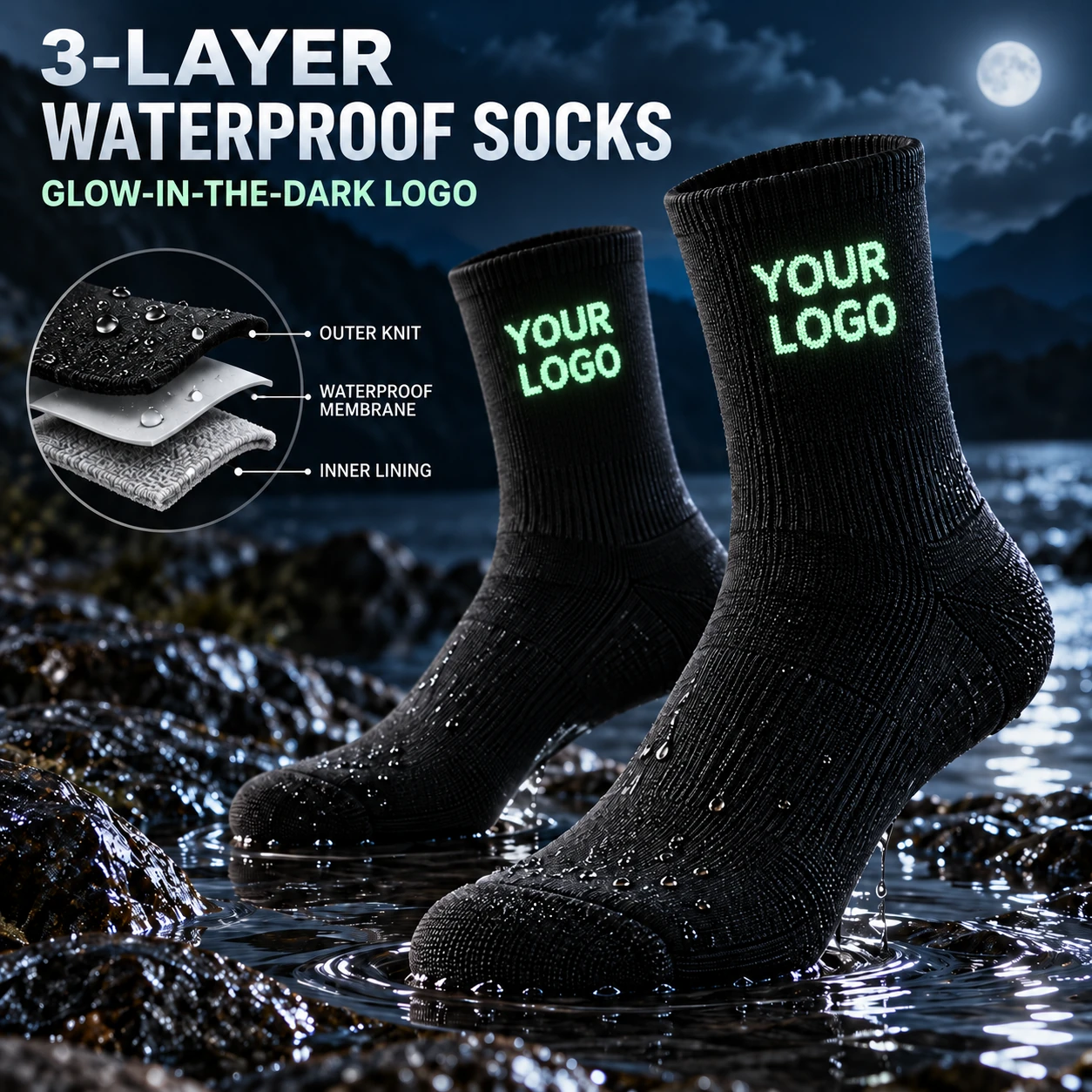
Glow-in-the-dark and reflective logos are not the same
Glow-in-the-dark material stores energy after exposure to daylight or a strong artificial light source, then releases that energy as a visible glow when the surroundings become dark. The effect starts brighter and gradually becomes dimmer. Initial brightness and visible duration vary with charging conditions, the selected luminous material, artwork coverage, viewing environment, wear and care.
Reflective material works differently: it returns light from an external source such as a vehicle headlamp. A glow logo can remain visible without a light shining on it immediately, while a reflective logo depends on incoming light. Buyers should choose the effect that matches the product concept and avoid presenting either decoration as a substitute for certified visibility or protective equipment.
The logo adds identity; the three-layer structure delivers waterproof performance
A typical waterproof sock combines a durable knitted outer, a waterproof breathable membrane and a comfortable skin-facing lining. The outer layer carries the colors, pattern and custom logo. The middle membrane provides the primary barrier against water moving through the sock body. The inner layer controls much of the next-to-skin feel, moisture contact, cushioning and warmth.
The luminous detail should be engineered on or with the outer construction so the membrane remains protected and continuous. Depending on the artwork and production route, the effect may use a compatible luminous yarn or another approved decoration. The method must be confirmed on a physical sample because stretch, lamination, color contrast and repeated flexing can change the appearance of the finished logo. Read our three-layer waterproof sock guide for the role of each layer.
Design artwork that stays clear on a knitted, stretchable surface
Simple artwork with strong shapes and adequate line thickness usually reads more clearly than tiny lettering or a highly detailed mark. The factory should review a vector logo when possible, then confirm the achievable size, luminous area and color against the selected outer knit. A simplified luminous icon can be paired with the complete brand identity on a label or package when the original artwork is too complex.
Placement also matters. The upper leg below the ribbed cuff is often visible and less compressed by a shoe, but the logo should not sit across a zone that folds heavily or stretches so far that the artwork becomes distorted. Check the mark with the sock both relaxed and worn. It should be centered, straight and positioned consistently on the left and right socks.
Choose a thickness and lining for the real footwear
A glow logo can be combined with different product builds. A medium-weight construction is useful when customers need a balanced waterproof sock that fits comfortably inside hiking shoes, cycling footwear or everyday outdoor shoes. Stretch and grading should be evaluated across the complete size range rather than assumed from one sample size.
For winter ranges, a thicker terry-loop inner lining can add cushioning and help retain warmth. The extra volume must be tested inside the intended boot because an overly tight fit can compress the lining and reduce comfort. The membrane remains the water barrier; the warmer feel comes mainly from the inner yarn, terry construction, retained air and the complete sock-and-footwear system. See the winter membrane and terry lining guide for a fuller development checklist.
Match luminous branding to the collection
- Hiking and campingCreate a recognizable night-camp detail while keeping trail fit, abrasion and drying behavior practical.
- Fishing and huntingUse a restrained logo placement that supports the brand story without making unsupported safety claims.
- Cycling and running accessoriesControl overall sock thickness and treat glow as an identity feature, not a certified visibility system.
- Workwear collectionsConfirm footwear fit, wash durability and relevant market requirements before using performance language.
- Limited editionsCombine a dark outer color with luminous artwork for a stronger day-to-night visual contrast.
- Promotional productsCoordinate the sock logo with custom labels, retail boxes, hangtags and care information.
Build the glow effect into the OEM brief
A useful inquiry includes the vector logo, preferred luminous color, approximate logo size and placement, outer colors, sock height, size range, lining, target thickness, quantity by size and color, packaging, sales market and intended use. Add reference images, but state which details are mandatory and which can be adjusted for production.
Also define how the glow will be judged. The sample should be exposed to the same light source for the same amount of time before candidates are compared in a controlled dark environment. Without a shared charging and viewing method, photographs and subjective impressions can make one sample appear better simply because it received more light. The waterproof socks tech pack guide shows how to turn these decisions into a clear development document.
Approve the sample in light, darkness and real use
- Normal-light appearanceCheck outer color, knit quality, artwork clarity and whether the luminous area looks acceptable before charging.
- Controlled glow reviewUse the agreed charging conditions, then record the initial effect and how it changes over the planned observation period.
- Logo alignmentConfirm that both logos are centered, straight, at the same height and visually balanced while worn.
- Exterior and interior videoShow the complete sock outside, the lining inside and the logo in normal light and darkness.
- Fit and stretchWear-test every planned size group with the intended footwear and watch for logo distortion or pressure.
- Waterproof constructionTest the finished sock with the agreed method; material data alone does not prove finished-product performance.
- Wash and durabilityRecheck glow, color, dimensions, lamination and artwork after the proposed care procedure and agreed cycles.
- Packaging proofDescribe charging, care and product limits accurately, then approve labels, barcodes and pair matching.
Use accurate product claims
Product pages should explain that the logo requires light exposure, becomes dimmer over time and can look different under different viewing conditions. Avoid promises such as “always glowing” or a fixed duration unless the exact production sample has been tested with a named method and those conditions are communicated to customers.
Waterproof language should refer to the tested sock construction, not the logo. A standard sock cuff is still an opening, so water can enter from the top when the water level or runoff rises above it. Breathable also does not mean sweat-proof. Clear claims reduce customer confusion and make the luminous feature more credible.
Glow-in-the-Dark Logo Waterproof Socks FAQ
Does a glow-in-the-dark logo need a battery?
No. The luminous material absorbs light and releases the stored energy in darkness.
It must be charged by daylight or a suitable artificial light source first.
Does the logo glow permanently?
No. The effect gradually becomes dimmer. Brightness and visible duration depend on
the material, charging conditions, artwork, viewing environment, wear and care.
Is a glow logo the same as a reflective logo?
No. A glow logo releases stored light, while a reflective logo returns light that is
shining on it. Neither should be described as certified PPE without applicable testing.
Does the luminous logo make the sock waterproof?
No. The waterproof breathable membrane inside the three-layer construction provides
the primary water barrier. The logo is a branding feature on the outer sock.
Can the socks use a warmer terry lining?
Yes. A thicker terry-loop interior can be developed for winter use, but samples should
be tested in the intended footwear to control bulk and pressure.
What should a buyer send for a custom sample?
Send the logo file, placement, preferred luminous color, sock height, sizes, lining,
thickness, outer colors, quantity, packaging, target market and intended application.
How should the sample be approved?
Review normal-light and dark-room appearance, left-right alignment, exterior and
interior construction, fit, waterproof performance, wash durability and packaging.