
How do you make waterproof socks warmer for winter?
A waterproof breathable membrane is essential for keeping external liquid water from passing through the sock body, but the membrane is not the main source of winter insulation. For a warmer OEM design, buyers can specify a thicker terry-loop inner lining, suitable yarns and a construction that retains comfortable air without making the sock too bulky for the intended boot. The result must be approved as a complete finished sock—not as separate membrane and lining materials.
- Water barrier
- A waterproof breathable membrane resists liquid water through the sock body.
- Warmth system
- Terry depth, lining yarn, overall thickness, retained air and footwear work together.
- Comfort
- Moisture handling, stretch, seams, pressure and drying behavior affect real wear.
- Fit
- Extra terry adds volume, so samples must be worn in the target winter footwear.
- Use limit
- The cuff is an opening; water entering over it is not a membrane failure.
- Claims
- Waterproof, breathability and warmth language should match finished-product evidence.
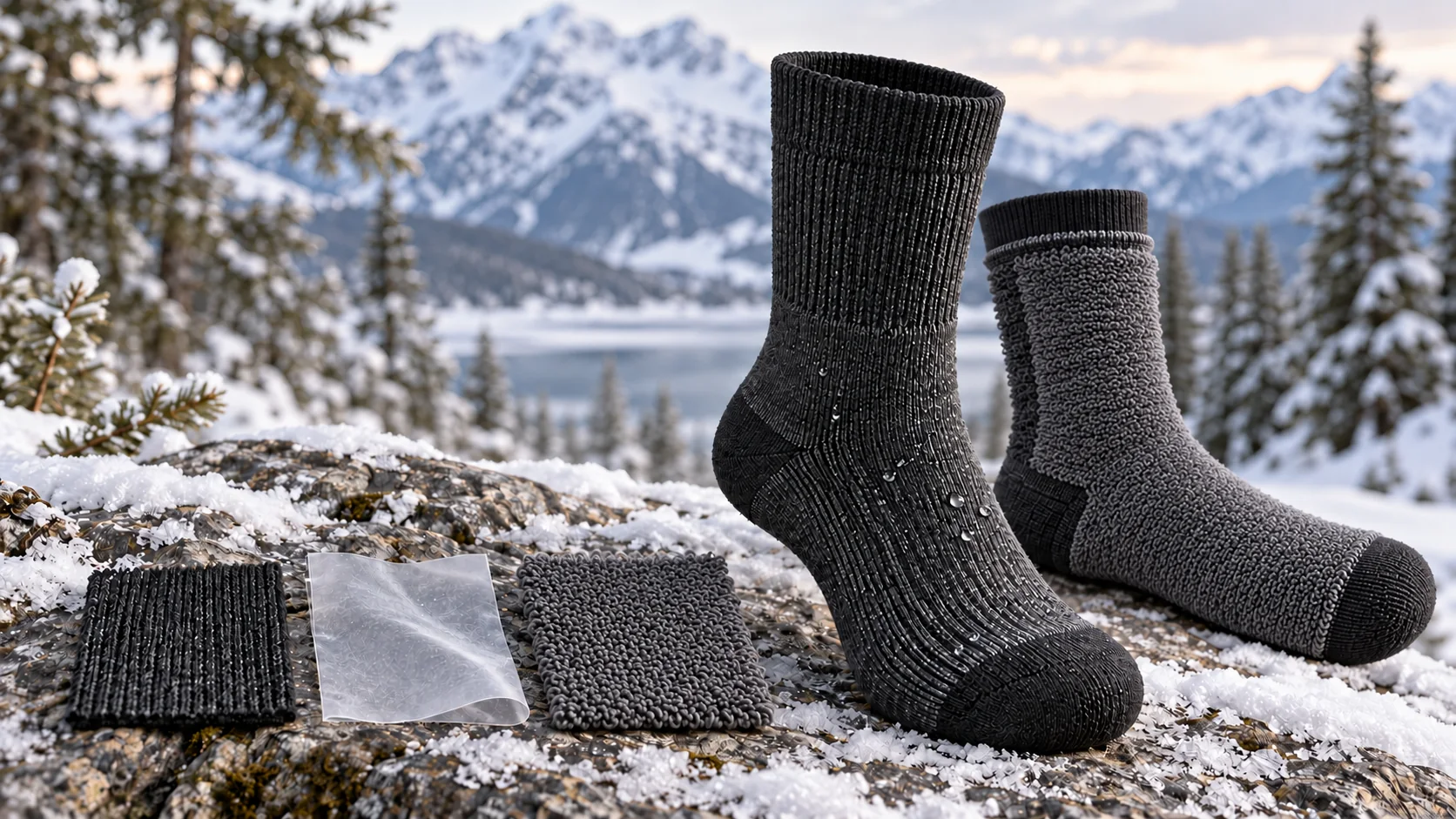
Think of a winter waterproof sock as one performance system
A typical three-layer sock combines a protective knitted outer, a waterproof breathable membrane and a skin-facing knitted lining. The outer helps protect the functional layer from abrasion and supports the product’s appearance. The membrane provides the primary barrier against water moving through the sock body. The inner lining controls much of the feel, cushioning, moisture contact and warmth experienced by the wearer.
Winter development changes the balance among these layers. A heavier outer can add protection, while a thicker looped lining can improve the feeling of warmth. However, every addition affects stretch, total volume, weight and drying. Review the complete construction alongside the basic three-layer waterproof sock principle, then build the sample around a defined temperature, activity and footwear scenario.
What “waterproof and breathable” means in winter
A suitable membrane is designed to resist liquid water while allowing a degree of moisture-vapor transfer. This is useful in cold weather because activity still generates heat and sweat. Breathability can help manage the humid microclimate inside the sock, but it does not mean the foot will never perspire or always feel dry.
Vapor movement depends on the membrane, adhesives, outer fabric, inner lining, temperature and humidity difference, footwear ventilation and activity level. A dense winter boot and a thick absorbent lining can slow moisture release even when the membrane itself is breathable. Buyers should avoid “sweat-proof” wording and instead develop a construction appropriate for the expected cold, exertion and wear time. Our separate membrane sourcing guide explains membrane fundamentals in more detail.
Warmth comes mainly from the lining and the total product design
The membrane blocks water, but buyers should not assume it creates meaningful insulation by itself. Winter warmth is influenced more directly by the inner yarn, terry-loop depth and coverage, overall material thickness, compression on the foot and the air held within the sock-and-boot system. The wearer’s circulation, activity, weather exposure and footwear insulation also matter.
A thicker terry interior increases cushioning and can retain more insulating air when it is not crushed. Wool-rich or other selected performance blends may support warmth and moisture management, while synthetic fibers can contribute strength, drying behavior and shape retention. Exact fiber percentages should be chosen for the target product, price and care expectations rather than copied from a generic “winter” specification.
Design the terry lining by zone, not only by weight
Full terry from toe to cuff can create a plush, warm product for roomy boots and lower-output activities. Targeted terry can concentrate cushioning and insulation under the foot, around the toe or at selected leg zones while controlling bulk and moisture retention elsewhere. A non-terry or lower-profile section at the instep may improve shoe fit for some styles.
Specify the loop position, density, pile height and yarn rather than requesting “extra thick” without measurements. Loops should feel consistent and remain stable after wear and care. Too much loose pile may create friction, bunching or long drying times. The factory should also confirm how the lining construction stretches and bonds with the other layers across every planned size.
Balance insulation, perspiration and drying time
More terry is not automatically better. Thick loops can absorb or hold more moisture from the foot, and that moisture must eventually leave through the system or be removed during drying. If the product is too warm for the activity, increased perspiration may reduce comfort and make the lining feel damp even though rainwater never crossed the membrane.
Define whether the sock is for stationary cold, moderate hiking, winter cycling, work, fishing or daily commuting. A low-activity product can prioritize insulation; a high-output product may need less pile, better moisture-spreading yarns or targeted terry. Trial more than one thickness when the market covers several activities. A midweight version and a warmer heavy version are often easier to explain than one construction promoted as suitable for every winter condition.
Allow enough space inside the boot
Thick winter socks occupy more space than lightweight styles. If footwear becomes tight, the terry is compressed, toe movement decreases and local pressure can reduce comfort. A thicker sample may therefore feel colder or less comfortable than expected when forced into a close-fitting shoe. This is a product-fit issue, not necessarily a failure of the membrane or lining material.
Test samples in the exact categories customers will use: insulated hiking boots, rubber work boots, fishing boots, winter cycling shoes or casual footwear. Record toe room, heel hold, arch pressure, cuff fit and ease of removal after wear. If a brand expects fitted shoes, compare the construction with the thin-versus-thick sourcing guide before approving a heavy full-terry design.
Match construction to the winter application
- Hiking and trekkingBalance warmth with walking moisture, boot volume, ankle flex and repeated abrasion.
- Fishing and outdoor workConsider lower activity, prolonged cold, rubber boots, cushioning and long wear periods.
- Winter cyclingControl bulk carefully because cycling shoes can be narrow and activity generates considerable heat.
- Hunting and observationPrioritize warmth for periods of low movement, then test walking comfort and drying between uses.
- Commuting and retail outdoorUse a versatile thickness, clear sizing and realistic warmth language for mixed conditions.
- Kids’ winter rangesReview fit, easy care, cuff entry, labeling and market-specific safety or compliance requirements.
The cuff is not a watertight seal
The membrane can protect the knitted sock body, but the top remains an opening. Snow, rain runoff or water above the sock height can enter over the cuff. A taller sock increases coverage but does not turn a standard cuff into a dry-suit seal. Product pages and packaging should explain this limitation clearly.
For deep snow or heavy runoff, the sock should be evaluated with the planned trouser, gaiter and boot combination. Cuff shape, grip and comfort can be developed to reduce slipping, but “waterproof” claims should remain tied to the tested sock body and actual use conditions.
Build a precise winter tech pack and RFQ
A useful brief identifies use, climate, activity level, sock height, size range, footwear, outer yarn, membrane requirement, lining fiber, terry zones, target thickness, colors, branding and packaging. Add quantity by size and color plus the intended sales market. Avoid relying on an undefined label such as “thermal grade.”
State the performance claims you hope to use, the evidence required and the care method customers will receive. Include drawings for terry coverage and key measurements for the finished sock. The custom waterproof socks tech pack guide provides a fuller checklist for converting a concept into a comparable supplier quote.
Approve samples through finished-product testing
- Water resistanceUse an agreed method on the finished construction and inspect all relevant sock zones.
- Moisture and comfortWear-test at the intended activity level, duration, weather and footwear combination.
- Warmth comparisonCompare candidate builds under the same controlled protocol; do not infer warmth from thickness alone.
- Fit and volumeMeasure finished thickness and assess pressure, movement and sizing inside target boots.
- Drying behaviorRecord moisture pickup, inside-out handling where permitted and time under the stated care conditions.
- DurabilityCheck flexing, abrasion, washing, dimensions, terry stability and layer integrity after agreed cycles.
Membrane material data does not automatically prove the finished sock’s waterproof, vapor-transfer or thermal performance. Confirm the test method, units, specimen, size and conditioning. Keep an approved reference sample and use the pre-bulk testing guide to align factory and buyer inspections.
How thicker winter construction affects MOQ and cost
Unit cost may change with lining yarn, fiber blend, terry coverage, knitting time, membrane specification, lamination, sock height, reinforcements, size range and testing. Special yarn colors or custom materials may carry their own minimums. A heavier sock can also affect packaging dimensions, carton quantities and freight.
Ask for quotations against named constructions, not “standard” and “premium” labels alone. Separate sample, testing, custom yarn, packaging and one-time setup charges. If the initial volume is limited, start with a proven platform and adjust lining, color and branding within feasible minimums. The OEM pricing guide explains the other variables buyers should compare.
Care instructions are part of winter performance
Thick terry may require more drying time than a lightweight lining. Provide care directions validated for the actual fibers, membrane, adhesive and decoration. High heat, unsuitable chemicals or rough handling can shorten product life, while storing a damp sock can create odor and comfort complaints.
Test the proposed wash and drying process before printing packaging. Explain whether the sock may be turned inside out, how it should be dried and what treatments to avoid. Clear care information protects both the technical construction and the customer’s expectations.
Winter Waterproof Socks FAQ
Does the waterproof membrane make a sock warm?
The membrane is primarily the water barrier. Winter warmth comes from the complete
design, especially the lining yarn, terry thickness, retained air and footwear system.
Can a waterproof sock also be breathable?
Yes. A suitable membrane can resist liquid water while allowing some moisture-vapor
transfer, but breathability does not guarantee a sweat-free foot.
Is full terry always warmer than targeted terry?
Not in every use. Full terry adds insulation and bulk, while targeted terry can place
warmth and cushioning where needed and preserve more space or moisture movement elsewhere.
Why must winter waterproof socks be tested inside boots?
Thick terry increases volume. Tight footwear can compress the lining, restrict movement
and create pressure, changing comfort and perceived warmth.
Can water enter through the cuff?
Yes. A standard cuff is not watertight, so snow, rain runoff or water above the sock
height can enter from the top.
How should a buyer compare warmth claims?
Compare finished products under the same defined method and conditions. Fiber names,
terry weight or membrane data alone do not prove a finished sock’s thermal performance.
What information is needed for an OEM winter sample?
Provide activity, climate, footwear, sock height, size range, desired terry zones,
lining fiber, thickness, quantity, branding, claims, test plan and target market.