
What should an OEM buyer test before approving waterproof sock colors?
Colorfastness is not one universal pass-or-fail test. It is a group of controlled evaluations that answer different questions: whether the sock itself changes color, whether dye stains another material and whether moisture, friction, care or storage increases the risk. The buyer should select applicable methods, specimen conditions, target grades and retest rules before sample approval.
- Color change
- Measures how much the tested sock, yarn or panel changes from its original shade.
- Staining
- Measures dye transferred from the specimen onto an adjacent reference material.
- Wet-risk focus
- Wet rubbing, perspiration and water exposure matter for socks used in damp footwear.
- High-risk styling
- Dark shades beside white yarn, pale logos or light shoe linings deserve extra review.
- Common grading
- Grey scales commonly run from 1 to 5, but the required result must be agreed in writing.
- Approval basis
- The method, edition, target, sample stage, lab and retest rule belong in the tech pack.
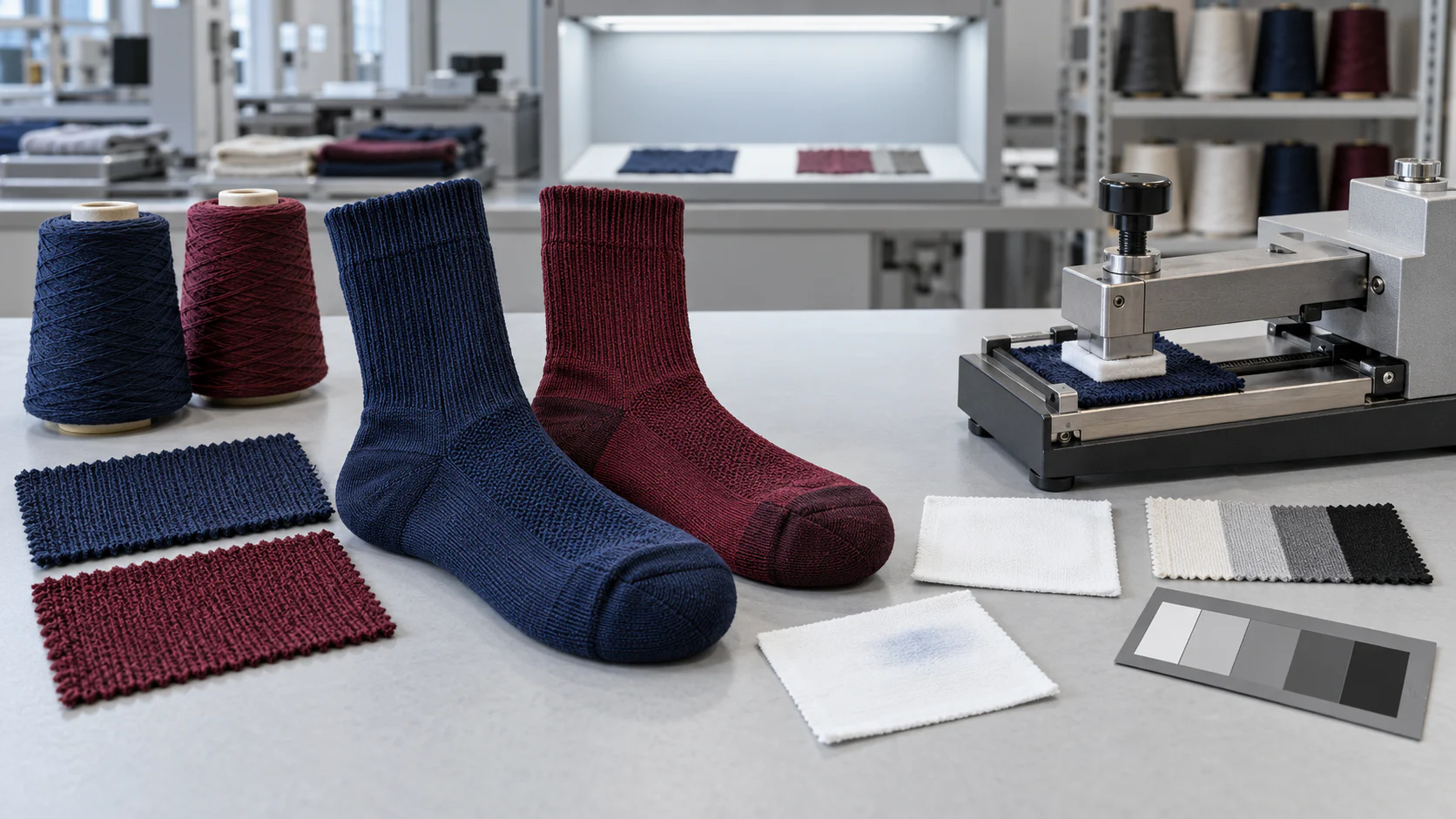
A visual color match cannot prove colorfastness
A sample can match the approved color standard under a light box and still release dye when it is wet or rubbed. Visual shade approval answers whether the color looks correct at that moment. Colorfastness testing asks whether that color remains stable under a defined exposure and whether it transfers to another material.
Waterproof socks combine outer yarns, elastic yarns, a membrane, an inner lining, reinforcement zones and sometimes labels or applied logos. Each colored component can behave differently. Testing only a loose yarn or only one fabric swatch may miss a risk created by the finished construction.
Separate color change from staining
Color change describes fading, darkening or another visible change in the specimen itself. Staining describes color transferred to an adjacent reference fabric. The two results should be recorded separately because a sock may retain its overall appearance while still staining a white shoe lining.
This distinction is especially important for black, navy, red and other deep shades, as well as styles combining a dark foot with pale jacquard artwork. The buyer should specify whether the concern is the sock shade, staining of adjacent materials or both.
Use a named method instead of saying only “test the color”
Test names, conditions and editions are not interchangeable. For example, ISO 105-C06 addresses colorfastness to domestic and commercial laundering, ISO 105-X12 addresses rubbing, and ISO 105-E04 addresses perspiration. A buyer using AATCC methods can review the organization’s official colorfastness module for the relevant method families.
These references describe standardized laboratory routes; they do not create one universal acceptance grade for every retailer. The importing brand, laboratory and supplier should agree the applicable method and current edition for the destination market and product program.
Colorfastness to laundering checks fading and cross-staining
A laundering test exposes the specimen and specified adjacent material to a defined detergent, temperature, mechanical action and time. The report can assess the color change of the sock material and staining on the adjacent fabric. It is not the same as casually washing one pair at home without controlling the conditions.
The test route should reflect the proposed care instruction. If the care label calls for a gentle low-temperature process, approval data from an unrelated severe route may not predict the labeled use. Conversely, an easy showroom rinse should not be used to support a claim about repeated consumer washing.
Dry and wet rubbing answer different footwear questions
Rubbing, also called crocking, evaluates whether color transfers when a reference cloth moves across the textile surface. Dry rubbing represents friction without added moisture. Wet rubbing adds a more demanding moisture condition that can be relevant when a sock is worn after rain, perspiration or water exposure.
For a finished waterproof sock, the test location matters. The footbed, heel, toe, cuff, reinforcement yarn and printed or transferred logo may not produce the same result. Record the tested zone rather than reporting one grade as if it represents every component.
Perspiration testing matters for next-to-skin products
Perspiration methods evaluate resistance to defined artificial perspiration conditions. They are useful for activewear socks because the inner lining and yarns can remain warm and damp during use even when the membrane prevents outside liquid water from reaching the foot.
A perspiration result should identify the solution condition, the evaluated color change and the staining result. It should not be replaced by a subjective wear note such as “no visible bleeding after one hike.” Field use can supplement laboratory data, but it does not control the exposure.
Colorfastness to water is separate from waterproof performance
A colorfastness-to-water check asks whether the textile color changes or stains an adjacent material under a defined wet condition. It does not measure the membrane’s resistance to water penetration and does not prove that a finished sock is waterproof. These two properties need separate acceptance evidence.
This distinction prevents a common specification error. “Pass water test” could mean no dye transfer, a dry inner lining, a material hydrostatic-pressure result or a finished-sock immersion check. The purchase file should name the exact question.
Storage dye transfer can appear after the product has passed inspection
Dark and pale components held in close contact can create a storage-transfer risk, particularly when products enter polybags with residual moisture or remain in warm, humid conditions. Folded cuffs, paired socks, paper inserts, woven labels and pale logo areas should be reviewed in the packed configuration.
Buyers can define a controlled storage-transfer evaluation when their styling or route to market creates this risk. The packaging team should also confirm that socks are properly dried and conditioned before bagging. A laboratory result does not excuse poor moisture control during production or packing.
Prioritize dark shades, high contrast and white contact surfaces
Risk-based testing normally starts with the most demanding shade and construction, not the easiest pale sample. Black, navy, saturated red, fluorescent shades, dark terry linings and contrast color blocking often deserve focused review. A white or pale reference material can make transfer easier to detect.
Footwear contact should also guide the plan. If the target customer is likely to wear the sock inside white sneakers, ski-boot liners or light-colored work boots, the buyer may request an additional controlled contact check using a representative lining material. That check should be identified as a buyer-specific validation, not misrepresented as an international standard.
Logos and trims need their own approval route
Jacquard artwork uses colored yarn and may be covered by the selected textile method. Heat transfers, silicone marks, printed labels, woven labels and embroidery introduce different pigments, adhesives and contact surfaces. Their adhesion and appearance after care should be reviewed in addition to any color-transfer requirement.
Test the final logo color on the final sock color. A white transfer approved on a grey prototype may behave differently on a saturated black production shade. Keep an approved sealed sample that shows placement, shade, edges and surrounding fabric.
Use grey-scale grades carefully
Colorfastness reports commonly use grey scales from 1 to 5, with higher numbers indicating less visible change or staining. The result may be a whole grade or an intermediate grade such as 3–4, depending on the method and assessment. A grade only has meaning when it is tied to the named property, method and condition.
There is no single grade that automatically applies to every waterproof sock, country, retailer, color or use case. A brand may set different targets for dry rubbing, wet rubbing, washing and perspiration. Record those targets before testing; do not choose a pass limit after seeing the result.
Test the right stage and control bulk changes
Development testing should use the intended yarn suppliers, dye recipes, lining, outer knit, reinforcement and logo method. A result from an early substitute sample should not automatically release a changed production construction. Bulk shade lots may also need verification when the order uses multiple dye lots or when a critical dark shade changes supplier.
Final inspection can identify visible stains and shade inconsistency, but it cannot reproduce all controlled colorfastness exposures. Define when third-party testing, an internal laboratory check or a documented comparison against the approved lot is required. Also define who pays for retesting after a material or process change.
Put the complete colorfastness matrix in the tech pack
A short matrix prevents the words “color test passed” from being interpreted in different ways by the buyer, factory and laboratory. Include every approved style, risk shade and component that needs separate evidence.
- Method and editionName the ISO, AATCC or buyer-specific procedure and the agreed edition.
- Test conditionState wet or dry, solution, temperature, time, pressure and adjacent material as applicable.
- AssessmentSeparate color change from staining and identify the evaluated sock zone.
- Target resultRecord the agreed grade for each property before samples are sent to the laboratory.
- Sample stageDefine prototype, sales sample, pre-production sample, bulk lot or packed-product testing.
- Sampling ruleState colors, sizes, lots and the number of specimens required.
- Change controlRequire review after changes to yarn, dye recipe, supplier, logo, lining or finishing.
- Failure routeDefine corrective action, resampling, retest approval and responsibility for cost or delay.
Waterproof Socks Colorfastness FAQ
What is the difference between color change and staining?
Color change is the visible change in the tested sock material itself. Staining is
dye transferred from that material to an adjacent reference fabric. A sock can show
little overall fading while still staining a light shoe lining.
Which colorfastness tests are most relevant to waterproof socks?
The plan commonly considers laundering, dry and wet rubbing, perspiration and water.
Storage dye transfer may also be relevant for dark-and-light combinations packed in
close contact. The buyer should select methods for the actual materials and use case.
Does a colorfastness-to-water test prove the sock is waterproof?
No. Colorfastness to water evaluates color change and staining under a defined wet
condition. Waterproof performance requires separate evidence for the membrane,
finished construction and agreed below-cuff water test.
Is grade 4 a universal passing requirement?
No. Grey-scale results commonly run from 1 to 5, but there is no universal passing
grade for every method, shade, retailer or market. The tech pack should state the
agreed target for each named test before testing begins.
Should every color in a waterproof sock order be tested?
The sampling plan depends on risk, buyer policy, dye lots and material changes. New
dark shades, high-contrast styles and colors using different dye recipes often need
priority. The buyer and supplier should document which colors and lots represent the order.
Can final visual inspection replace laboratory colorfastness testing?
No. Inspection can find visible shade differences or stains but does not reproduce
controlled washing, rubbing, perspiration or storage exposure. Use inspection and
applicable testing for different parts of the quality plan.
Do custom logos need separate colorfastness approval?
Often yes. Jacquard yarn, heat transfers, silicone marks, embroidery and labels use
different materials and processes. Review the final logo on the final sock shade for
color transfer, appearance and adhesion after the agreed care route.
What should a buyer send when requesting colorfastness testing?
Send the final color standard, construction, logo method, target market, care label,
named methods and editions, target grades, sample stage, colors and lots to test,
approved laboratory, report format and retest rule.