
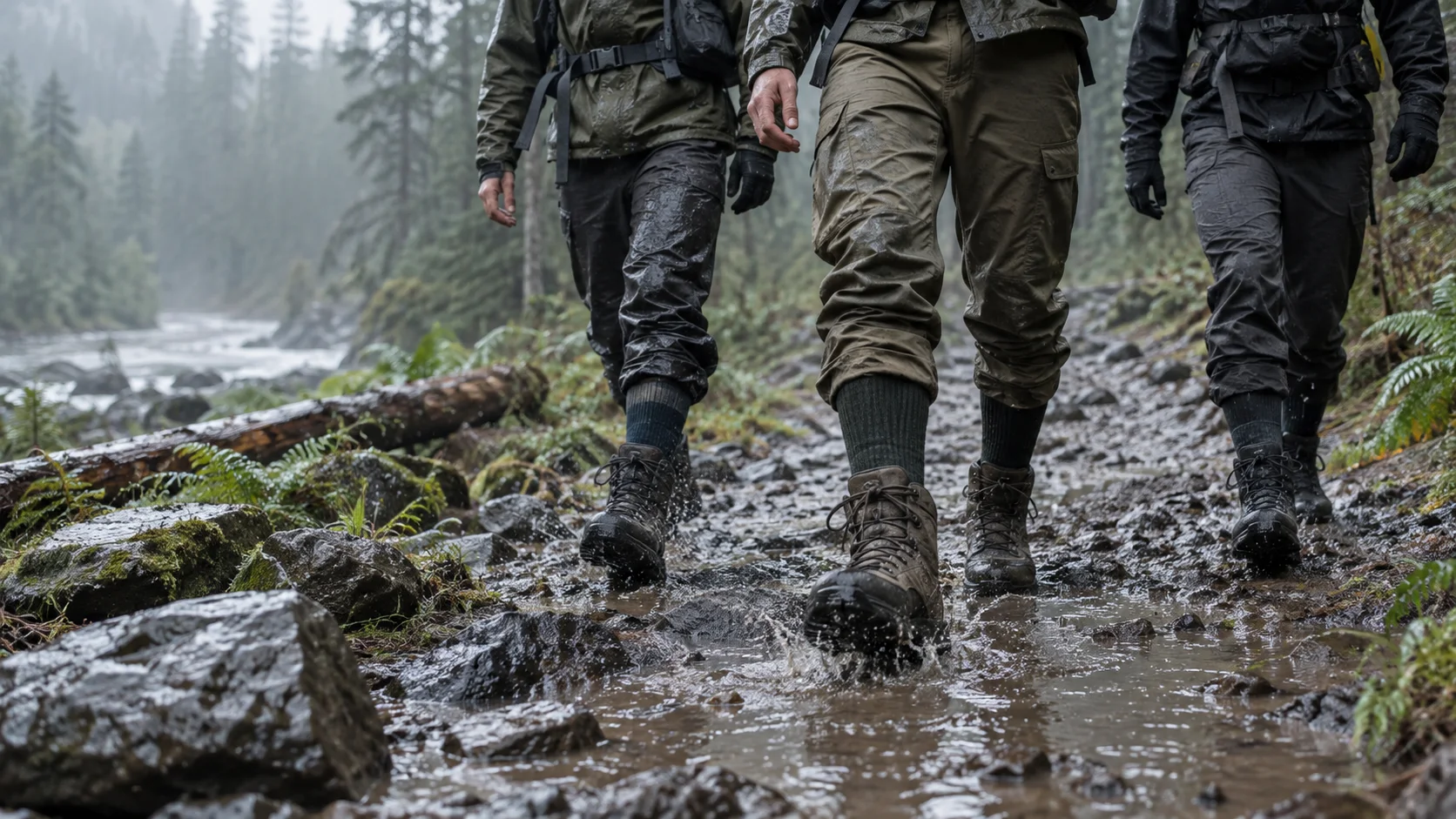
Procurement decisions for wet-weather operational footwear
Tactical waterproof socks are not selected by color alone. Buyers need a clear operating profile, the actual boots used by the team, realistic water-entry limits and an agreed test plan. The result should protect mobility and comfort without creating excessive footwear volume or unsupported performance claims.
Start with the mission profile
Define where and how the socks will be used before choosing a construction. Record expected temperature, rainfall, mud, wet vegetation, standing water, activity level, shift duration and access to replacement clothing. A fast-moving search team in cool rain may need a different lining and thickness from a low-activity team positioned for long periods in winter conditions.
Also separate routine wet-weather use from specialist hazards. Waterproof socks can help manage water passing through non-waterproof footwear or entering around wet ground, but they do not replace certified protective boots, chemical protection, puncture protection or an organization's occupational safety procedures.
Treat the sock and boot as one system
Ask the supplier to evaluate samples inside the issued boot models. A three-layer sock is usually thicker and less elastic than a standard knitted sock, so an otherwise correct foot size may feel tight in low-volume footwear. Pressure around the toes, heel and instep can reduce comfort during long movements.
Wear trials should include lacing, walking, kneeling and the full combination of base layers, trousers or gaiters used in the field. If several boot brands are in service, test the highest-volume and lowest-volume examples rather than assuming one fit result will represent every user.
Select height for the actual exposure
Mid-calf socks suit many hiking-style and tactical boots, while knee-high designs add coverage for taller boots, deep wet vegetation and cold-weather programs. The cuff should sit where it is not trapped by a boot edge or restrictive strap. Height must be reviewed together with calf circumference, stretch and the user's uniform layers.
A standard knitted cuff is still an opening. Water can enter from above when the cuff is submerged, when rain runs down the leg or when saturated clothing directs water inside. A cuff strap or grip feature may help the sock stay in position, but buyers should not present it as a guaranteed watertight seal unless the finished design has evidence for that specific claim.
Balance durability, warmth and moisture management
The outer knit should suit abrasion from boots, vegetation and repeated handling. The waterproof membrane provides the water barrier, while the lining affects next-to-skin feel, warmth and moisture management. Nylon blends, Merino blends and moisture-management synthetics can each support different priorities.
Breathability does not mean the inside will always feel dry. Sweat production, temperature, activity level and footwear ventilation all matter. The buyer should evaluate the complete sample during realistic movement and rest cycles instead of selecting a material from a single specification number.
Protect circulation with a practical size plan
A field program may need more than a simple small, medium and large size label. Build the size chart around foot length and the target boot range, then review calf fit for taller styles. Confirm whether the users will wear a separate liner sock because that changes both volume and the way the waterproof sock moves against the foot.
Cold and wet conditions make footwear management especially important. Official cold-weather guidance from CDC/NIOSH and the Defense Health Agency emphasizes keeping feet dry, changing damp socks and avoiding footwear conditions that interfere with circulation. Product instructions should support, not replace, those operational practices.
Build a layered verification plan
Material-level data and finished-sock checks answer different questions. For example, ISO 811 describes a hydrostatic-pressure method for measuring fabric resistance to water penetration. That data can help compare barrier materials, but it is not by itself proof that every finished sock will perform identically in use.
Agree on finished-product water checks, dimensional measurements, appearance standards, stretch, abrasion direction, wash cycles and inspection sampling before bulk production. Field trials should record boot model, route, duration, weather, activity and user feedback. Keep the cuff above the water when the intended test is for penetration through the sock body.
Use controlled colors, branding and traceability
Common field palettes include black, charcoal, navy, olive and earth tones. Confirm colors under the intended lighting and against the rest of the uniform. Logos should be positioned so they remain readable without creating a hard or bulky area inside the boot. Official insignia and protected marks should only be used with documented authorization.
Packaging may be minimal for institutional issue or more detailed for retail and distributor channels. In both cases, size, material, care, lot reference and product identity should remain clear. Batch traceability makes it easier to connect inspection records and user feedback with a specific production run.
Plan care, rotation and replacement
Operational buyers should decide how socks will be washed, dried, issued and replaced before rollout. Care instructions need to match the approved materials and any waterproof membrane limitations. High heat, harsh treatment or improper drying can shorten service life, while storing damp socks can create hygiene and odor problems.
One pair should not be treated as a complete moisture-management plan for continuous deployment. Provide enough rotation for washing and drying, and instruct users to inspect for visible damage or persistent performance changes. Replacement criteria should be simple enough for both supervisors and individual users to apply consistently.
Send suppliers a procurement-ready brief
A useful request includes team application, climate, boot types, desired sock height, estimated quantity, size distribution, lining preference, colors, logo, packaging, test requirements, destination market and target delivery window. State whether the project is a field trial, first order or replenishment program.
Ask for a written specification, representative samples and a defined approval route before bulk production. Our waterproof socks sample checklist, size grading guide and bulk inspection guide can be used to organize the next steps.
Tactical Waterproof Socks FAQ
Are tactical waterproof socks personal protective equipment?
Not automatically. Classification and tender requirements depend on the jurisdiction, intended use and claimed protection. Confirm the applicable requirements with a qualified compliance team and do not claim certification without supporting evidence.
Which height is best for field teams?
Mid-calf designs suit many tactical boots, while knee-high designs add coverage for taller boots and deeper wet vegetation. Test the height with the actual footwear and uniform layers.
Will the sock stay dry if the cuff is submerged?
A normal cuff is an open entry point, so water can enter from above. The waterproof claim should be limited to the tested sock body unless a specialized closure has been validated.
What tests should an OEM buyer request?
Use relevant material data plus finished-sock water checks, measurements, workmanship review, wash evaluation and representative wear trials in the issued boots.
Can tactical colors and private labels be customized?
Yes. Colors, logos, size labels and packaging can be developed for the program, subject to material availability, MOQ and authorization for any official marks.